
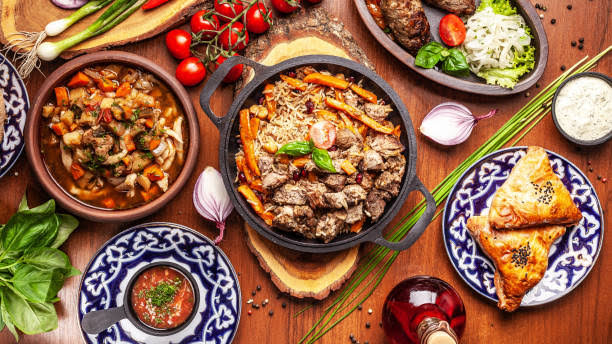
Introduction
Local foods of Kazakhstan are trendy. Generally, most people are fond of local foods from any place. Nomadic life laid the foundations of the Kazakh national cuisine many centuries ago. The people’s harsh lifestyle in harsh climatic conditions required a lot of energy, and as a result the local diet has long included hearty dishes made from filling and readily available ingredients such as meat and milk products.
Table of Contents

Today local foods of Kazakhstan is a symbiosis of old and new traditions. For example, earlier Kazakh cuisine had no side dishes and meat alone could be part of an entire meal. It was only after the Kazakhs became sedentary and began to be influenced by surrounding countries that their diet included fruits, vegetables, fish, flour products and sweets.
Contrary to popular belief, Kazakh local foods are not monotonous and you will rarely find two identical servings of the same dish from one region to another. Recipes are often passed down for generations and each chef, whether it is a chef of a famous restaurant or a housewife, has his or her own special secrets. Kazakhstani local foods can also be healthy, as it is usually prepared with fresh and natural ingredients. Kazakhs are hospitable people who are known to share their local foods with everyone who comes over for tea.
Local Foods of Kazakhstan
Guests are treated with great respect and are fed abundantly by local foods. Yet, gatherings are about more than just food, which is just one symbol of the hospitality and people-oriented culture for which Kazakhs are known.
Kazakh Meat Dishes – Local Foods of Kazakhstan
Kazakh local foods can be summarized in one word: meat. Any proper lunch or dinner will include meat, and traditional cuisine is full of dishes with horse meat or lamb meat as the main ingredient. Beef is used less often in Kazakh cuisine, while poultry does not even qualify as meat for the average Kazakh. Beshbarmak (beshbarmak) is the national dish of Kazakhstan, and as such is served at almost every feast. This dish, made of thin sections of boiled meat and homemade noodles, is usually served with broth on a large communal plate.
Beshbarmak is sometimes called “Kazakh-style meat” in Russian. Kuyrdak (roast meat) is usually served before the main course of beshbarmak. Sirne (sirne), young lamb fried with onions and potatoes, is one of the most beloved Kazakh meat dishes. Kazy and shuzhik are two types of homemade horse sausages that are often seen on the table on holiday.
The two most popular local meat dishes, laghman and manti, deserve special attention:
Kazakh Laghman -Local Foods of Kazakhstan
Kazakhs consider this dish their own, although laghman actually has its roots in Uyghur cuisine. Most of the approximately 275 thousand Uyghurs in Central Asia live in Kazakhstan, and it was their ancestors who first introduced this dish to Kazakh cuisine. Kazakh laghman is made from long noodles, meat (usually lean beef) and vegetables. You can use any vegetables you like, but bell peppers, onions, Chinese cabbage, spices and herbs are the most traditional. Laghman can be served as a soup in broth or as a noodle dish with a thick vegetable gravy.

Kazakh manti – Local Foods of Kazakhstan
Kazakh manti are steamed dumplings filled with minced meat. The meat filling is flavored with onions and spices and then placed in the center of a small piece of dough, which is then folded around the meat. Manti are cooked in a special tiered steamer and are often eaten with kaymak (sour cream) or tomato sauce. If you are looking for vegetarian food in Kazakhstan, manti can sometimes be found filled with potatoes instead of meat.

Kazakh soups– Local Foods of Kazakhstan
Sorpo is the most common soup of Kazakhstan. It is also called shorpo or shurpa soups. To prepare sorpo, lamb is boiled in water until it is cooked through. The broth is then strained and poured into a bowl and chopped meat is added to it. Nowadays sorpo often also includes potatoes and carrots.
Kespe is a Kazakh soup consisting of egg noodles, carrots and herbs added to a boiled broth.
Naryn is a soup made from beshbarmak meat broth and very thin noodles mixed with finely chopped meat.

Kazakh dairy products– Local Foods of Kazakhstan
Kazakh dairy products hold a special place in the national cuisine. These mainly include fermented milk products and dishes that require these ingredients. Some of the most popular include:
kurt – dried balls of sour milk, salt and sometimes pepper that are 2–5 cm in diameter;
Irimshik – mildly sweet hard cheese made from cow or sheep milk;
Kaymak – fresh cream similar to sour cream;
Kurt and irimshik can be eaten as separate foods, while kaymak is usually eaten with bread or added to soups.

Kazakh fish dishes– Local Foods of Kazakhstan
Despite being a landlocked country, the Kazakh national cuisine also includes fish dishes. Despite not being as common as meat-based meals, they occupy a central place on the table when they are served. The most famous of Kazakh fish dishes is koktal, a hot, smoked fish cooked on a skewer and served with vegetables. Southern Kazakh people love a dish called karma, which is boiled fish with noodles and generously dipped in butter.

Kazakh bread products– Local Foods of Kazakhstan
It is impossible to imagine the local cuisine without Kazakh bread products. Baursaks are small pieces of square or round leavened dough that are fried in oil and served with tea, soups and main dishes. A very traditional food of Kazakhstan, baursaks are such an important part of the local cuisine that a famous proverb says: “Besbarmak-kuyrdak-baursak, and you can do without the rest!” Shelepeki is a thin unleavened bread which is fried in oil.
Tandoor naan is everyday leavened bread baked in a clay oven (tandoor) and served with every meal. Ak-nan is a flat cake with onions baked into the dough. It is often served with besbarmak. Samsa, puff pastries filled with meat, potatoes or cheese, is one of the most quintessential street foods in Kazakhstan.

Kazakh Drinks– Local Foods of Kazakhstan
Kazakh cuisine includes food and unusual drinks. Black tea is very popular both at home and in social gatherings. Green tea is less common, except for the so-called Tashkent tea, which is a mixture of black and green tea with lemon and honey. Shubat and kumis (kumis) are made from camel and mare milk, while katyk and ayran are obtained from cow milk. Sharchay is black tea with milk, salt, butter, flour and fried tail fat. It is usually served only at home. Kefir is consumed either as a separate drink or mixed with hot breakfast cereals. It is full of health-promoting properties for the skin and digestive system.
Fermented milk products are very popular Kazakh drinks. Shubat and kumis (kumis) are made from camel and mare milk, while katyk and ayran are made from cow milk.
Sharchay is black tea with milk, salt, butter, flour and fried tail fat. It is usually served only at home.
Kefir is either drunk alone or mixed with hot breakfast cereals. It is full of healthful properties for the skin and digestive system.

Kazakh sweets– Local Foods of Kazakhstan
Kazakh national cuisine would be incomplete without dessert. Although desserts do not play a major role in the local diet, the Kazakh desserts that are typically served are worth a taste.
Shak-shak (shek-shek) is made from small pieces of dough that are fried in oil and mixed with honey. It is usually garnished with raisins and nuts before serving.
Balkaymak is a stewed cream. As the cream is cooked over low heat, flour and honey are added gradually until a light brown mass is formed. Balkaymak is best eaten with hot baursaks.
Zent is a Kazakh dessert made from cottage cheese, millet, sugar, butter, and raisins. Generally it is prepared on special occasions.
Kazakh Holiday Foods– Local Foods of Kazakhstan
The diversity of food in Kazakhstan is nowhere more evident than during holiday gatherings.
Nauryz kozhe is a festive dish with seven symbolic components: meat, water, salt, cereals, butter, flour and milk. The most traditional type is made with broth, onions, katyk, kurt, kumis and boiled meat, kazy, barley and millet.
Sumalak is sprouted wheat that must be constantly stirred while simmering throughout the day. The end result is a thick, semi-sweet paste that can be eaten alone or with bread. Sumalak is also traditionally made for Nauryz.
Pilaf is made from rice, meat, onions, carrots, raisins, chickpeas, garlic and spices and is becoming more common in holiday gatherings.
Kazakhstan cuisine is an experience in itself, a unique expression of Kazakhstani culture that you must explore during your trip!
Conclusion
Kazakhstan food is an experience in itself, a unique expression of Kazakhstani culture that you’ll definitely want to explore during your trip!


